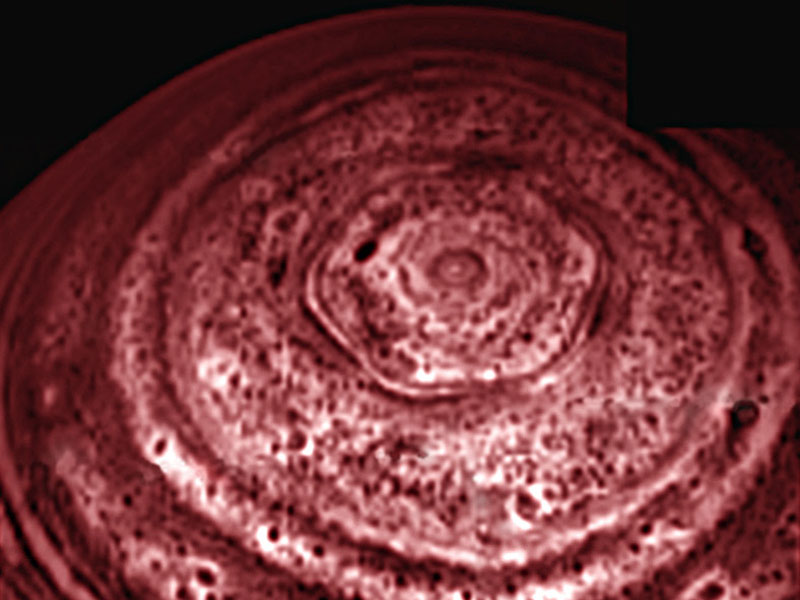
It's strange how a hexagon with equal sides can appear on the North Pole! It's so perfectly shaped, it's an abnormal sight. Maybe this has to do with the weather and the cloud and storm formations.
I have known about this for a while and I have to say my take on it is that some oddity in Saturn's magnetic field has something to do with it. As for the eye, that is easier: let's say that Saturns day is about the same as Jupiter's (9.925 earth hours). Traveling at not very high velocity per second (9.69 kilometers per second; Earth travels at about 29.783 kilometers per second) its bound to be circular. Here is another analogy: say you have a large piece of clay and you put it on a potter's wheel and your hands are like gravitational fields acting on Saturn, it quickly turns circular because all sides are being forced upon with the same amount of pressure. If you don't understand this, just think about it and it will come to you.
I thought it was a cool discovery. But really, how or what would it help for science? Even though it is awesome that there is a hexagon at one pole and a hurricane at another, how could this help us? We could discover irregular weather patterns basically anywhere! Anyways, I like Howard's analogy of the clay on a potter's wheel because it is basically being compressed on each side and then you get a circle. But one question: why are there mountains and valleys if there is soooooooooo much pressure? Also, wouldn't Saturn's asteroids be pushed onto Saturn if this force is so strong? And if Jupiter has such a strong gravity, why wouldn't Jupiter's ring of asteroids be compressed on it? I hope NASA can discover these questions.
Noah, to answer your question, mountains and crevices/valleys occur for various reasons. Mountains are created by tectonic plate disturbances. Crevices are also formed when tectonic plates move. Valleys and the like are largely due to an asteroid collision.
I agree with Noah, this is a great discovery but how will it help us? I t was really strange that a hexagon with equal sides is laying in our north pole. Why is it a hexagon, why isn't is a square or a triangle.
What is a hexagon doing on the north pole of saturn? Im not sure what its significance is to science is. Its weird, no doubt but the fact that its there cant really help us with science can it? I found the entire article somewhat confusing. But I still thought it was amazing how perfectly shaped it was.
This is SO cool! I mean, I knew that science and math are related, but I never knew geometry would be on a planet!!! I agree with Noah, what is this hexagon so important? I also can't imagine a square or a triangle, Dharian...
Some people are saying that this discovery won't help science. One question... how do YOU know that? I mean, after all, maybe this discovery will lead to finding something else. Perhaps in this hexagon, there is some sort of life form living under it. You never know. I just think that instead of immediately finding the negative on the subject, perhaps try to the about some of the ways it could advance science. Instead of shooting down an AMAZING scientific discovery, try to learn more about it. And let's admit it... it's hard to find something like that on Saturn. We should applaud this discovery. I thought it was cool article and I loved that scientists are able to learn things like that.
I truly think that this is amazing! Strange, but amazing. It is very interesting, but as Kento411 said, I never would have imagined GEOMETRY on a planet. Perhaps this has to do with the admosphere...? The hexagon looks so precise... I wonder if it is a perfect hexagon (in terms of length). If it were, how fascinating it would be for scientists!


11 comments:
It's strange how a hexagon with equal sides can appear on the North Pole! It's so perfectly shaped, it's an abnormal sight. Maybe this has to do with the weather and the cloud and storm formations.
I have known about this for a while and I have to say my take on it is that some oddity in Saturn's magnetic field has something to do with it. As for the eye, that is easier: let's say that Saturns day is about the same as Jupiter's (9.925 earth hours). Traveling at not very high velocity per second (9.69 kilometers per second; Earth travels at about 29.783 kilometers per second) its bound to be circular. Here is another analogy: say you have a large piece of clay and you put it on a potter's wheel and your hands are like gravitational fields acting on Saturn, it quickly turns circular because all sides are being forced upon with the same amount of pressure. If you don't understand this, just think about it and it will come to you.
I thought it was a cool discovery. But really, how or what would it help for science? Even though it is awesome that there is a hexagon at one pole and a hurricane at another, how could this help us? We could discover irregular weather patterns basically anywhere! Anyways, I like Howard's analogy of the clay on a potter's wheel because it is basically being compressed on each side and then you get a circle. But one question: why are there mountains and valleys if there is soooooooooo much pressure? Also, wouldn't Saturn's asteroids be pushed onto Saturn if this force is so strong? And if Jupiter has such a strong gravity, why wouldn't Jupiter's ring of asteroids be compressed on it? I hope NASA can discover these questions.
Noah, to answer your question, mountains and crevices/valleys occur for various reasons. Mountains are created by tectonic plate disturbances. Crevices are also formed when tectonic plates move. Valleys and the like are largely due to an asteroid collision.
I agree with Noah, this is a great discovery but how will it help us? I t was really strange that a hexagon with equal sides is laying in our north pole. Why is it a hexagon, why isn't is a square or a triangle.
What is a hexagon doing on the north pole of saturn? Im not sure what its significance is to science is. Its weird, no doubt but the fact that its there cant really help us with science can it? I found the entire article somewhat confusing. But I still thought it was amazing how perfectly shaped it was.
This is SO cool! I mean, I knew that science and math are related, but I never knew geometry would be on a planet!!! I agree with Noah, what is this hexagon so important? I also can't imagine a square or a triangle, Dharian...
Some people are saying that this discovery won't help science. One question... how do YOU know that? I mean, after all, maybe this discovery will lead to finding something else. Perhaps in this hexagon, there is some sort of life form living under it. You never know. I just think that instead of immediately finding the negative on the subject, perhaps try to the about some of the ways it could advance science. Instead of shooting down an AMAZING scientific discovery, try to learn more about it. And let's admit it... it's hard to find something like that on Saturn. We should applaud this discovery. I thought it was cool article and I loved that scientists are able to learn things like that.
This article was well written. It is interesting that a hexagon was found that could fit 4 earths in it. This was an amazing discovery.
I have to admit that is a little weird. I have never seen anything so straight on a planet. Like i said... Weird
I truly think that this is amazing! Strange, but amazing. It is very interesting, but as Kento411 said, I never would have imagined GEOMETRY on a planet. Perhaps this has to do with the admosphere...? The hexagon looks so precise... I wonder if it is a perfect hexagon (in terms of length). If it were, how fascinating it would be for scientists!
Post a Comment